I. ANGELS ACCORDING TO THE BIBLE AND THE INTERESTAMENTAL WRITINGS#
A. THE OLD TESTAMENT TERMS AND TEXTS#
1. Terms Clearly Referring to Angelic Beings
a. Mal’ak, “Messenger” or “Angel”
The Hebrew noun mal’ak was derived from the verb l’k, meaning “to send”, but the verb “is not found in extant Hebrew but in Arabic and Ethiopic literature”. It is by far the “most frequently used term to designate angel beings” in the Old Testament. Although the word is used to refer to human prophets (2 Chr. 36:15-16; Isa. 42:19; 44:26; Hag. 1:13), to human priests (Eccl. 5:5; Mal. 2:7), and to the winds (Ps. 104:4), its predominant usage was in reference to suprahuman messengers of God.
Mal’ak is translated by the English word “angel” 111 times in the KJV Old Testament, but this total includes the references to “the angel of Yahweh”.
30 of these occurrences are in the Pentateuch
59 are in the Former and Latter Prophets
22 are in the Writings
According to Genesis, angels made a visit to a human household (19:1, 15), helped to procure a wife for Isaac (24:7, 40), and were both seen in Jacob’s vision at Bethel and active in his life (28:12;; 31:11; 32:1l 48:16; compare Hos. 12:4).
According to Exodus, an angel went before and behind the Israelite army (14:19) and before the advancing children of Israel (23:20, 23; 32:34; 33:2).
In the books of Samuel and Kings, an angel is used in similes (1 Sam. 29:9; 2 Sam. 14:17, 20; 19:27), was said to have destroyed Jerusalem through a plague (2 Sam. 24:16-17), and spoke to an old prophet (1 Kings 13:18).
According to the Psalms, there are both destroying angels (78:49) and guardian angels (91:11), and in the single reference in Job (4:18) angels were said to be charged by God with error.
In Zechariah, we find recurrent angelic appearances to and speaings with the prophet himself (1:9, 11-14, 19; 2:3; 4:1, 4-5; 5:5, 10; 6:4-5), and in Daniel the rescue of Shadrach, Meshach, and Abednego (3:28) and the sutting of the mouths of lions in Daniel’s behalf (6:22) were attributed to angels.
b. Cherub (kerub) (plural, cherumbim [kerubim])
The second most frequently employed term for angelic beings was kerub, it being found in a dozen texts. Of the various theories concerning its etymology, W.G. Heidt has faovred an Assyrian origin by which it meant those who interceded “at the court of king or god”. Yet the actual uses in the Old Testament point in other directions.
Cherubim were placed as guardians of the Garden of Eden (Gen. 3:24).
Hammered golden likenesses of the cherubim with extended wings were placed on the top of the ark in the tabernacle (Exod. 25:18-20)
Solomon caused wooden cherumbim overlaid with gold to be placed in the holy of holies in the new temple and carved cherubim to be placed on its walls and doors (1 Kings 6:23-28, 29, 32, 35)
Repeatedly Yahweh is said to have been “enthroned between the cherubim” (1 Sam. 4:4; 2 Sam. 6:2; Ps. 80:1b; 99:1b; Isa. 37:16)
Ezekiel 10 portrays the cherubim at the throne of God and identifies them with the “four living creatures” seen by the prophet (1:5)
Poetically, David sees Yahweh mounting the cherubim and riding on them (2 Sam. 22:11; Ps. 18:10)
c. Holy Ones (qadosim)
The term qados, “holy one”, was used in five texts of angelic beings. Its etymology is the same as that of the term when applied to God.
The “assembly” (KJV) or “council” (NIV) of the “holy ones” reverences God (Ps. 89:7).
According to the theology of Eliphaz, Job cannot turn to any of the “holy ones” (15:15).
These “holy ones” will accompany Yahweh on “the day of Yahweh” (Zech. 14:5), and Daniel records his having heard a “holy one”, who was being addressed by “another holy one” (8:13).
d. Heavenly Host, or Hosts of Heaven (saba)
The Hebrew saba, which is used of the stars, seemingly connotes angels in 1 Kings 22:19 par. 2 Chr. 18:18; Ps. 103:21, and Ps. 148:2. Neh. 9:6 seems more debatable.
W.G. Heidt concluded that this root does not suggest military forces but rather bondage or servitude assigned by One who is free.
e. Watcher (‘ir)
Only in Daniel is the Hebrew word ‘ir used, derived from a verb meaning “to rouse oneself, awake”. It appears three times in the same passage (4:13, 17, 28), twice in the singular and once in the plural and twice joined with the term “holy one”.
f. Sons of God (bene ‘Elohim, bene ‘Elim)
There is widespread agreement that “sons of ‘Elohim” in Job 1:6 and 2:1 means angelic beings, and the same may be said of “a son of the gods” in Dan. 3:25 (NIV). It is probable that “sons of ‘Elim” in Ps. 29:1 and 89:6 refers to angels. It is possible, as A.B. Davidson suggested, that “‘Elohim” in Ps. 8:5 and Ps. 97:9 and “‘Elim” in Exod. 15:11, and even Ps. 82:6, may be understood as referring to angels.
But what of “sons of ‘Elohim” in Gen. 6:1-2,4? Is that text to be taken to refer to angels so that it involves the marriage of angels and human women? Because the same text has been invoked in support of fallen angels, it will be necessary to treat the text in the subsequent chapter on Satan and evil spirits.
The preferable interpretation seems to be that Genesis 6 refers to the marriages between Sethite men and Cainite women
g. Seraphim (serapim)
The word serapim is used only once in the Old Testament (Isa. 6:2-3). There have been many conjectures concerning its etymology, and thus there has been little agreement. Heidt has contended that “the casual way in which our author introduces them without any further explanation is sufficient evidence that the concept was familiar to his readers”.
h. Other Rarely Used Common Nouns or Substantives
Certain Hebrew terms such as are translated “the mighty”, “mediator”, and “ministers” are also used of angels in the Old Testament but used only once or twice.
i. Gabriel
In two instances, both in the book of Daniel, specific angels are given personal names in the Old Testament. Gabriel, meaning literally “a man of God”, appears to Daniel, first for the interpretation of his dream (8:16) and subsequently while Daniel was praying for the bestowal of “insight and understanding” (9:21-22).
j. Michael
The angel Michael is thrice mentioned in Daniel (10:13, 21; 12:1), and each time he has a princely function. He is called “one of the chief princes”, “your prince”, and “the great prince”. Some interpret 12:1 to mean that Michael was to serve as guardian angels for the Jewish people.
2. “The Angel of Yahweh”, “The Angel of God”
In the interpretation of the Old Testament one of the major enigmas seems to have been the identity of the one was is called “the Angel of Yahweh”. This specific term may be found in the following passages:
| Gen. 16:7, 9 | 2 Kings 1:3, 15 |
| Gen. 22:11, 15 | 2 Kings 19:35 |
| Exod. 3:2 | 1 Chr. 21:12, 15-16, 18, 30 |
| Num. 22:22-27, 31-32, 34-35 | Ps. 34:7 |
| Judg. 2:1, 4 | Ps. 35:5, 6 |
| Judg. 5:23 | Isa. 37:36 |
| Judg. 6:11-12, 20-22 | Zech. 3:1, 5-6 |
| Judg. 13:3, 13, 15-17, 20-21 | Zech. 12:8 |
In addition, “the angel of God” was used in Gen. 21:17; 31:11; and Exod. 14:19; “the Angel who has delivered me from all harm” in Gen. 48:16; “my angel” in Exod. 32:34, and “the angel of his presence” in Isa. 63:9.
There have been four major theories as to the identity of the Angel of Yahweh, and its is now necessary only to state clearly the central idea and supporting considerations of each.
a. Logos Theory
This thesis is that the Angel of Yahweh is the preexistent Logos who would later become incarnate in Jesus Christ. Some would even refer to the Angel as “the second person of the Trinity”. This view was popular among the Church Fathers and has had its adherents through the centuries.
Early in the twentieth century Arno Clemens Gaebelien (1861-1945) held to this view, and E.Y. Mullins found it difficult to move away from it. Heidt reported in 1949: “No one in recent years has advocated this view; it may be considered obsolete”. But in 1975 William Franklin (Billy) Graham (1918-) and Guy Bernard Funderburk (1902-) advocated it.
b. Angelic Theory
This view holds that the Angel of Yahweh was an angel and therefore a created spiritual being who acted in special ways as the ambassador or representative of Yahweh. It appeals as being a literalist view of the matter. It often claims that this angel was received and listened to as a divine ambassador.
Heidt cited modern Catholic, Protestant, and Jewish authors who have taken this position, but he argued against it partly because there are no claims in these passages that the Angel is an inferior representing his superior.
c. Interpolation Theory
This theory, the product of biblical criticism, holds that during the long history of Israel and her sacred books some came to realize that certain passages referred to Yahweh in such anthromorphic terms that such passages were in need of alteration and hence redactors inserted “Angel of” into such texts. M.J. Lagrange was a principal exponent of this theory. It makes of the Angel of Yahweh a literary device and thereby bypasses the question as to whether God or a special angel is intended.
d. Instrumental Theory
This view, described by Heidt as the “identity theory”, regards the Angel of Yahweh as “the visible or audible phenomenon through which God manifests himself and communicates with the person or persons concerned”. The Angel is thus the instrument of divine communication.
A.B. Davidson understood these passages as theophanic, David Muir Gibson Stalker declared that the Angel “is… Yahweh himself, in so far as he reveals himself”, and Dale Moody identified the Angel as “the personal presence of the Lord”. This view seems to pose fewer difficulties and to have more convincing appeal than the others.
B. THE INTERTESTAMENTAL JEWISH WRITINGS#
In the books of the Old Testament Apocrypha and of the Pseudepigrapha, most of which were written during the second and first centuries B.C. and the first century A.D., the conceptions of the nature and activities of angelic beings found in the Old Testament were both continued and expanded.
Among the expanded concepts were specific accounts of the creation of angels and more specific ideas about angel guardians over individuals and over nations and about orders or ranks of angels, especially the role of named archangels, either seven or four in number.
In the rabbinical literature, consisting of the Targums, the Midrashim, and the Talmud, a similar pattern is found. New concepts include Metatron as the highest of the archangels, a council or company of angels, 70 (or 72) angels over the nations, and angels as occupying the highest of the seven heavens but not as near to God’s throne as righteous humans.
C. THE NEW TESTAMENT TERM AND ITS MANY USES#
The term for angels in the New Testament is aggelos, which literally means “messenger” or “agent”. According to Gaebelein, the New Testament mention angels 165 times. A count of the uses of aggelos translated as “angels” in the KJV, listed by Young, totals 179.
The numnerous uses of aggelos can be found in every type of New Testament literature. Although occasionally aggelos was used for human messengers (Luke 7:24; 9:52; Jas. 2:25) and for John the Baptist as the “messenger” promised by Malachi (Mal. 3:1; Mark 1:2; Matt. 11:10), the overwhelmingly predominant usage was in reference to suprahuman beings.
1. Synoptic Gospels
The angel Gabriel announced the birth of John the Baptist to his father Zechariah (Luke 1: 11-20) and the birth of Jesus to Mary the virgin (Luke 1:26-38).
An angel announced to Joseph the virginal conception of Mary’s child (Matt. 1:20-25), an angel gave to Jesus his name before his conception (Luke 2:21), and angels praised God at the birth of Jesus (Luke 2:9-15).
An angel appeared to and instructed Joseph in Egypt after Herod’s death (Matt. 2:19-20).
Angels ministered to Jesus after his wilderness temptations (Mark 1:13 and par.).
In the parable of the tares the “reapers are angels” and will gather up evildoers (Matt. 13:39, RSV); according to the parable of the net, angels will come forth at the end of the world to separate the wicked from the righteous (Matt. 13:49); in the parable of the lost coin angels in heaven are said to rejoice “over one sinner who repents” (Luke 15:10); and in the parable poor Lazarus is carried by angels to Abraham’s bosom (Luke 16:22).
Angels in heaven do not marry (Mark 12:25 and par.), but they “behold” the face of God the Father (Matt. 18:10).
The Son of Man will come in glory “with the holy angels” to be ashamed of those now ashamed of him and to acknowledge those who acknowledge him (Mark 8:38 and par.; Luke 12:~9; Matt. 25:31), andhewillsendforthhis angels to gather the elect (Mark 13:27 and par.). But angels in heaven do not know the “day” or “hour” of Jesus’ parousia (Mark 13:32 and par.).
While Jesus was on the cross, “an angel from heaven” appeared to him to strengthen him (Luke 22:43), and God the Father was said to be able to send in Jesus’ behalf “more than twelve legions of angels” (Matt. 26:53).
An angel rolled away the stone before the tomb in which Jesus’ body had been placed, sat on it, and then spoke to the women who came early in the morning on the first day of the week to Jesus’ tomb (Matt. 28:2-5; compare Luke 24:23).
2. Gospel of John
Jesus spoke to Nathanael of a vision of “the angels of God ascending and descending upon the Son of Man” (1:51).
Mary Magdalene saw two angels in white sitting where Jesus’ body had lain in the tomb (20:11-13)
3. Acts of the Apostles
An “angel of the Lord opened the prison doors” for the release of the apostles (5:19).
According to Stephen, an angel had appeared to Moses at the burning bush (7:30, 35,38) and had delivered the law to men (7:53).
An angel directed Philip to go on the road from Jerusalem to Gaza (8:26).
An angel also appeared to Cornelius in Caesarea and directed him to send for Peter in Joppa (10:3-7, 22; 11:13).
An angel helped Peter to escape from prison (12:7-11), but some of the Christians insisted mistakenly that the one appearing was Peter’s “angels” (12:15).
The Sadducees disbelieved in angels, whereas the Pharisees believed in angeld (23:8-9).
Paul testified that during a storm at sea “an angel of the God to whom I belong and whom I worship” stood by him (27:23).
4. Pauline Epistles
The Lord Jesus will be “revealed from heaven with his mighty angels” for judgment (2 Thess. 1:7).
Even if “an angel from heaven” should preach to Galatian Christians a different gospel, they should not accept such (Gal. 1:8)
The law “was ordained by angels through an intermediary” (Gal. 3:19)
The apostles had “become a spectacle” “to angels” (1 Cor. 4:9)
Christians “are to judge angels” (1 Cor. 6:3), women are to wear veils on their heads “because of the angels” (1 Cor. 11:10), and human beings who speak with angelic eloquence and have not love “gain nothing” (1 Cor. 13:1-2)
“Satan disguises himself as an angel of light” (2 Cor. 11:14), and angels will not be able to separate Christians “from the love of God in Christ Jesus” (Rom. 8:38)
The “worship of angels” is rejected (Col. 2:18)
Jesus was “seen by angels” (1 Tim. 3:16) and Paul charged Timothy in “the presence” “of the elect angels” (1 Tim. 5:21)
5. General Epistles
Jesus is superior to angels (Heb. 1:4-7, 13; 2:5-7), though angels have declared valid messages (Heb. 2:2). Only for “a little while was [Jesus] made lower than the angels” (Heb. 2:9). In his incarnation Jesus was “concerned” primarily “ith the descendants of Abraham” rather than with angels (Heb. 2:16). The heavenly Jerusalem contains “innumerable angels” (Heb. 12:22). Hospitable Christians may have “entertained angels without knowing it” (Heb. 13:2).
Angels were interested in the prophet’s announcement of the Messiah (1 Pet. 1:12). God committed to Tartarus until final judgment the sinning angels (2 Pet. 2:4; Jude 6), and angels do not judge sinful humans (2 Pet. 2:11). But angels are ultimately subject to the risen Jesus Christ (1 Pet. 3:22).
6. Apocalypse
The word “angel” appears 76 times in the Apocalypse, that is, in every chapter except chapters 4, 6, and 13. But in chapters 2-3 “the angel of the church” seemingly refers to pastors or elders.
D. THE SIGNIFICANCE OF ANGELS IN THE BIBLE#
1. Creaturehood
The Bible assumes the existence of angels. The specific divine creation of angels, although assumed in the doctrine of creation of all things, is not formally taught in the Bible, unless Ps. 148:2-5 does imply such/
As created beings, angels are not to be worshiped, even though incipient Gnosticism may enjoin such (Col. 2:18). They are subordinate to Jesus the Son of God (1 Pet. 3:22; Heb. 1:4-6), who only in his incarnation and crucifixion was “made a little lower than the angels” (Heb. 2:9).
2. Multiplicity
The biblical concept of angels seems to include great numbers and varieties of angelic beings. The Hebrew terms saba, “host of heaven”, although more often used of the sun, moon, and/or stars, sometimes was indicative of angels.
Micaiah the prophet saw “the LORD sitting on His throne with all the host of heaven standing around Him on His right and on His left” (1 Kings 22:19b, par. 2 Chr. 18:18)
In Psalm 103:21a and 148:2, “heavenly hosts” refers to angels.
In Daniel “the Ancient of Days” is described as follows: “Thousands upon thousands attended him; ten thousand times ten thousdan stood before him” (7:10b)
At the birth of Jesus, “a great company of the heavenly host appeared with the angel” (Luke 2:13)
The “heavenly Jerusalem” is said to have “thousands upon thousands of angels” (Heb. 12:22b), and before the exalted Lamb of God “many angels, numbering thousands upon thousands, and ten thousands times ten thousand” will sing their praises to the Lamb (Rev. 5:11a).
3. Functions
a. Worship of God
The worship of God is undoubtedly one of the major angelic functions.
In Isa. 6:1-3 the seraphim call to each other: “Holy, holy, holy is the Lord Almighty [or LORD of hosts]; the whole earth is full of his glory”
According to Heb. 1:6, “when God brings His firstborn into the world, he says, ‘Let all God’s angels worship him’” (Deut. 32:43)
b. Obedient Service of God
This role of angels is specifically stated in Ps. 103:20 and implied in virtually all the other angelic functions.
c. Interpretation of the Word and Will of God
The cherubim, who were seen by Ezekiel as “four living creatures”, helped to communicate the message that the “glory” had departed from the temple of Yahweh (1:4-24; 10:1-22).
A “watcher” appeared to give instructions about the tree in the tree-dream of King Nebuchadnezzar (Dan. 4:13-23).
The angel Michael helped Daniel to interpret the vision of a man dressed in linen (10:4-21), and Gabriel helped Daniel to interpret the dream of a ram and a goat (ch. 8) and announced the births of John the Baptist (Luke 1:11-20) and of Jesus (Luke 1:26-38).
A similar annunciation was made to Joseph (Matt. 1:20-25), who also received angelic instruction while in Egypt (Matt. 2:19-20).
d. Special Agency vis-à-vis Salvation History
In the New Testament, Stephen alluded to an angel’s having appeared to Moses at the burning bush near Mount Sinai (Acts 7:30, 35), and both Stephen and Paul referred to an angelic presence with Moses at the giving of the ten “living words” (Acts 7:38; Gal. 3:19).
Angels were said to have assisted Jesus during His wilderness temptations (Mark 1:13; Matt. 4:11), to rejoice over repentant sinners (Luke 15:10), to have strengthened Jesus while in Gethsemane (Luke 22:43), and to have performed various functions at the empty tomb of Jesus (Matt. 28:2-5; John 20:11-13).
In the Acts of the Apostles, angels were said to have been involved in the release of the apostles from prison (5:19), in directing Philip on the road to Gaza (8:26), in causing Cornelius to send for Simon Peter (10:3-7, 22; 11:13), in Peter’s escape from prison (12:7-11), and in encouraging Paul while in a storm at sea (27:23-26).
e. Guardianship of Human Beings
Does the Bible teach that particular angels act as guardians to specific human beings? Certain New Testament texts seem to provide an affirmative answer.
Jesus indicated that little children have “their angels in heaven” (Matt. 18:10b)
In the parable of the rich man and Lazarus, “the angels carried him [Lazarus] to Abraham’s side” (Luke 16:22)
After Peter’s release from prison, most of the disciples thought that the reappearing Peter was Peter’s “angels” (Acts 12:15)
II. ANGELS ACCORDING TO THE HISTORY OF CHRISTIAN DOCTRINE#
A. PSEUDO-DIONYSIUS THE AREOPAGITE#
The most developed doctrine of angels during the patristic age came late in the period in The Celestial Hierarchy, written by a pseudonymous fifth- or sixth-century Christian author.
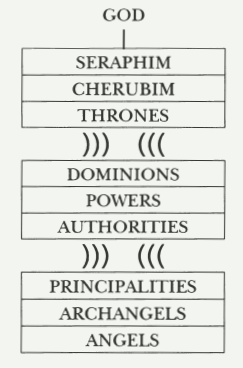
“Dionysius” took nine different names for angelic beings from the Bible and set them in a hierarchical order, borrowed from his teacher Hierotheus and consisting of three triads or choirs with three different types of angels in each. This hierarchy was taken to be “a sacred order, a state of understanding, and an activity approximating as closely as possible to the divine”, the goal of which was “to enable beings to be as like God as possible and to be at one with Him”.
The very blessedness of God consists of purification, illumination, and perfection, and the descending order of angels is designed to enable divine blessedness to be received from above and transmitted to beings below.
The nine parts of the angelic hierarchy are as follow:
B. THOMAS AQUINAS#
In his somewhat detailed treatment of angels, Thomas Aquinas known as “the angelic doctor”, concentrated on the being of angels, their relation to space, the knowledge had by angels, the will or volition of angels, the love exercissed by angels, the creation of angels, and their perfection unto beatitude.
It was indeed an otherworldly interpretation, and neither “Dionysius” nor Thomas made any serious effort to interpret the role of angels in the history of redemption.
C. TWENTIETH-CENTURY AUTHORS#
1. John Macquarrie: Angels as Necessary in the Order of Creation in the Service of Being
Among the twentieth-century authors who dealt with angels, Macquarrie is probably closer to “Dionysius” and Thomas than any. For him, the concept of angels “stands for the unity and order of the whole creation in the service of Being; not merely at the level of cosmic process, but at the level of conscious and free cooperation”.
Negatively, angels are not to be models or mediators for humanity. Humans are not to embrace “angelism”, or their own preoccupation with their spiritual and intellectual being to the neglect of their bodily nature. Like the cherubim outside the Garden of Eden, angels can constitute the limits for human beings, especially when tempted to undertake “lane-jumping”.
Positively, angels afford evidence that human beings are not alone in the cosmos and can point to the vastness of the created order.
2. Karl Barth: Angels as God’s Heavenly Ambassadors to Earth
Barth wrote a lengthy discussion of angels, placing it between a chapter on “God and Nothingness” and his treatment of demons. In the fine print, he provided a veritable history of the doctrine, giving special attention to “Dionysius”, Thomas, and the Continental Protestant dogmaticians. For him, the angels belong essentially to the heavenly kingdom or realm and serve obediently as God’s ambassadors or witnesses to the earthly realm.
3. Karl Rahmer: Conscious, Created, Finite Beings Subordinated to Christ/God
Rahner emphasized the late appearance of the concept of angels in the Old Testament writings, alleging its rootage in non-Israelite religions and contending that it did not result from any event in salvation history. In the postexilic period, it was both magnified (Job, Daniel) and minimized by silence (Priestly code).
Sadducees were influenced by Hellenistic rationalism to reject angels, but Jewish apocalypticism embraced belief in angels “but with a strict regard for the transcendence of God”
Much of past angelology can be considered optional now, but Rahner retianed the Catholic veneration of good angels and the role of guardian angels. Rahner sought to avoid two extremes:
One, the demythologization of angels or their being “trivialized into abstract idea”
The other, the exaggeration of angels “in a Gnostic or Manichean way”
Recognition of angels causes a person to realize that “he stands in a more comprehensive community of salvation and perdition than that of mankind alone”. Moreover, if people today expect that there are “intelligent living beings outside the earth”, why should men “reject angels outright as unthinkable”?
4. Billy Graham: Angels as Taught in Scripture, Confirmed by Experience, and Active Today
Graham stressed the differences between angels and human beings, angels as God’s messengers and as pointers to but not preachers of the gospel, angels as agents of protection and deliverance, of passage in death, and of judgment and fulfillment of prophecy, and the spectator role of angels.
III. PRESENT-DAY ATTITUDES TOWARD ANGELS#
It is important to specify and focus on those attitudes toward angels, their existence and their functions, which tend to prevail among present-day Christians.
A. REJECTION#
Since the era of the Enlightenment, many Christians have been influenced by that rationalistic antisupernaturalism which finds no possibility of the existence of supramundance or suprahuman beings, whether good or evil. Other naturalistic and secularizing influences may have augmented that influence, and in addition Bultmannian demythologization may have had its impact.
Specific reasons for rejecting the existence and work of angels may include the following:
The concept of angels is a relic of primitive beliefs which is totally unacceptable in a scientific age
Jesus accommodated to the prevailing Jewish belief in angels, making no issue over its validity, and hence Jesus’ authority should not be invoked in defense of angels.
The existence of angels and evil spirits is not taught or demanded by the sources of revelation
Belief in angels has stimulated the formation of related myths and hence should not be sustained.
B. INDIFFERENCE#
A second and widely prevalent attitude toward angels is that of indifference, based either on an uncertainty about the existence of angels or on the assumed irrelevance of angels to the important issues facing modern Christians or on some other basis.
C. ACCEPTANCE#
What are the basic reasons why some Christians do positively accept the doctrine of angels?
The existence and activity of angels are assumed and described in numerous books of he Old and the New Testaments. A high view of the inspiration and authority of the Scripture seems to call for the attitude of acceptance.
The acceptance of the reality and work of angelic beings serves to limit human arrogance as to man’s being the solitary climax of all creation
Belief in angels can strengthen the faith of Christians in the power and providence of God.
The existence and activity of angels are consonant with the possibility of living beings on planets other than the earth